The BSRS (Biometric-Enabled Scholarship Registration System) is the newer system used by the tesda-bsrs-vs-tesda-t2misTESDA Explained: Technical Education and Skills Development Authority for scholarship registration, identity verification, and attendance monitoring. The older TESDA T2MIS (Training Management Information System) mainly serves as TESDA’s central database for training records, certificates, and learner information. In simple terms, BSRS manages scholars and training attendance, while T2MIS stores long-term training and certification records.
Both systems still work together behind the scenes to help TESDA manage thousands of training programs across the Philippines. Understanding how they differ can save you time when applying for TESDA scholarships, enrolling in training, or checking your records.
TESDA BSRS vs T2MIS
To organize everything better, TESDA introduced online systems that help training institutions, trainers, and learners manage their data digitally.
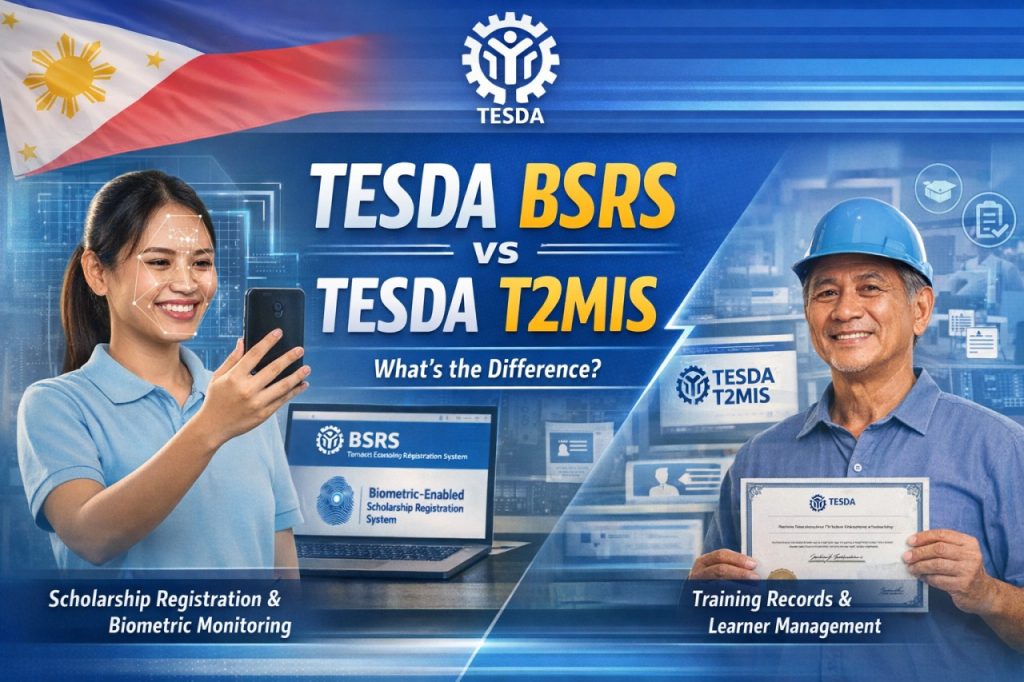
- TESDA T2MIS: the older national database introduced in 2017 for training and certification records
- TESDA BSRS: the newer system introduced in 2022 for scholarship registration, biometric attendance and verification of scholars’ identities, preventing fraudulent attendance or duplicate entries
Think of them as two connected tools working together to manage the entire training journey. BSRS was designed with the goal of improving some limitations of T2MIS, particularly in verifying scholar identity and preventing fraud.
Here’s a more detailed point of comparison for you:
1. Main Purpose
TESDA T2MIS: The TESDA T2MIS is a nationwide information system used to collect and manage technical-vocational training data.
- It records information such as:
- learner profiles
- training schedules
- training results
- certification records
- employment updates after training
- This system acts as the main database for TESDA programs and learners across the country.
TESDA BSRS: The BSRS focuses on scholarship programs.
- It allows scholars to:
- register online
- verify identity through facial recognition
- track attendance
- enroll in scholarship training programs
- It was created to add stronger monitoring and automation to scholarship implementation.
2. Authentication and Attendance
- T2MIS: Attendance in T2MIS traditionally relied on manual attendance sheets and reports submitted by training institutions. This made it harder to verify whether the listed trainees actually attended classes.
- BSRS: BSRS uses facial recognition biometric technology during registration and attendance tracking. This allows TESDA to confirm that:
- the person enrolled is the same person attending
- scholarship participants are real trainees
- attendance reports are accurate.
3. Registration Process
- T2MIS: In T2MIS, learner information is usually encoded by TESDA staff or training institutions. Once registered, the system assigns a Unique Learner Identifier (ULI)—a permanent code that tracks the learner’s progress from training to employment.
- BSRS: BSRS allows scholars to register directly online using their email and device camera. The system captures facial biometrics and creates a profile that scholars can reuse for future TESDA programs.
4. System Functions
- T2MIS mainly manages:
- training program records
- assessment results
- certification data
- employment tracking
- the Unique Learner Identifier (ULI) system
- It functions as TESDA’s long-term record system for learners.
- BSRS generally handles scholarship operations, including:
- scholar registration
- biometric attendance monitoring
- class monitoring for trainers
- scholarship program enrollment
- Some modules also support automated certificate generation with electronic signatures and QR codes, which can link to learner records stored in T2MIS.
5. Security and Data Integrity
T2MIS
While T2MIS organizes training data, it does not have built-in identity verification for scholars.
This made the system vulnerable to problems such as:
- duplicate entries
- “ghost trainees”
- inaccurate attendance reports.
BSRS
BSRS improves data accuracy by adding:
- biometric identity verification
- automated attendance tracking
- centralized monitoring of scholars.
These features help TESDA confirm that scholarship funds are used by real learners.
6. How the Systems Work Together
Even though BSRS is newer, it does not completely replace T2MIS.
Instead, the two systems work together:
- BSRS manages scholars and attendance
- T2MIS stores long-term training and certification records
For example, when training certificates are generated through BSRS modules, the information may still connect to T2MIS records for verification and printing.
Why TESDA Introduced BSRS
Before BSRS existed, scholarship management relied heavily on manual encoding and traditional attendance systems.
This made it harder to confirm if:
- Scholars were truly attending training
- Records matched the actual participants
- Scholarship funds were reaching the right people
BSRS changed this by introducing:
- Facial recognition for attendance verification
- Online scholarship registration
- Centralized digital records shared with trainers and TESDA offices
These upgrades help TESDA monitor programs more accurately while reducing paperwork for institutions.
How These Systems Help TESDA Scholars
For many learners in the Philippines, especially OFWs, returning OFWs, and out-of-school youth, these systems make TESDA training easier to manage.
With BSRS and T2MIS working together, scholars can benefit from:
- Faster scholarship registration
- Accurate attendance records
- Permanent training history through the ULI
- Easier verification of certificates
- Less repeated paperwork when enrolling again
This also helps TESDA offices monitor programs nationwide and track the progress of learners from training to employment.
Frequently Asked Questions (FAQs)
For your reference, here are some common questions and answers regarding these two TESDA systems:
1. Is TESDA BSRS an upgraded version of TESDA T2MIS?
No, TESDA BSRS is not exactly an upgraded version of TESDA T2MIS, although it was introduced later to improve some of its limitations. The BSRS focuses mainly on scholarship registration, identity verification, and biometric attendance monitoring. Meanwhile, TESDA T2MIS remains the central database that stores learner records, training schedules, assessments, certifications, and employment tracking. In practice, BSRS works alongside T2MIS, adding biometric verification and automation while T2MIS continues to manage the long-term training records of TESDA learners in the Philippines.
2. Are they interchangeable?
No, TESDA BSRS and TESDA T2MIS are not interchangeable because they serve different functions within the TESDA system.
3. Do I need a TESDA BSRS account to apply for a TESDA scholarship?
Yes. Most TESDA scholarship programs now require applicants to register in the TESDA BSRS. This system allows scholars to create a profile, verify their identity using facial recognition, enroll in training programs, and monitor attendance during the course.
4. Can I access TESDA training records using BSRS?
Not completely. BSRS mainly manages scholarship registration and attendance, while T2MIS stores official training records and certifications. This means your scholarship participation may appear in BSRS, but your long-term TESDA training history is usually stored in T2MIS.
For learners across the Philippines, these systems can make the journey into TESDA training smoother—and help you focus on what really matters: gaining practical skills for better work opportunities.
Contact Details
For inquiries and other concerns, you may reach out to TESDA via the contact information for the TESDA Head Office:
- Hotline: 8887-7777
- Email: contactcenter@tesda.gov.ph
- Facebook: TESDA Official
- Twitter/X: @TESDAOfficial
- Text (inquiries): 0917-479-4370
- Employment survey: 0954-239-3492