The Department of Social Welfare and Development (DSWD) is the government agency in the Philippines that handles social welfare, poverty reduction, and assistance programs for poor, vulnerable, and disadvantaged Filipinos. It runs programs like 4Ps, social pension, crisis assistance, and livelihood support to help families meet their basic needs and recover from hardship.
As for how it works with the Technical Education and Skills Development Authority (TESDA), DSWD identifies and endorses qualified beneficiaries—especially 4Ps members, out-of-school youth, returning OFWs, and indigent families—for free skills training, scholarships, and certification. Through joint programs like the Cash-for-Training Project and Sustainable Livelihood initiatives, DSWD provides financial assistance and profiling, while TESDA delivers skills training (including the TESDA Online Program or TOP) to help Filipinos gain employment or start a small business.
DSWD Explained
To better understand it, you can think of DSWD as the government’s helping hand for Filipinos who are struggling. Formed in 1987 through Executive Order No. 123, the DSWD leads social welfare and development efforts nationwide. Its mission is to develop and coordinate programs for the poor, vulnerable, and disadvantaged. Its vision is a soci%ety where people have fair access to opportunities for a better life.
You’ve probably heard of the DSWD because of:
- Pantawid Pamilyang Pilipino Program (4Ps): conditional cash grants for poor families
- Assistance to Individuals in Crisis Situations (AICS): financial and food aid during emergencies
- Sustainable Livelihood Program (SLP): skills and business support
- Social Pension (SocPen): monthly stipend for indigent senior citizens
- Disaster Risk Reduction and Management Program: relief and recovery during calamities
From food stamps to medical aid (LinGaP sa MaSa), from travel clearance for minors to support for trafficked persons (RRPTP), DSWD covers social protection for all genders and ages across the country.
So, How Does DSWD Work with TESDA?
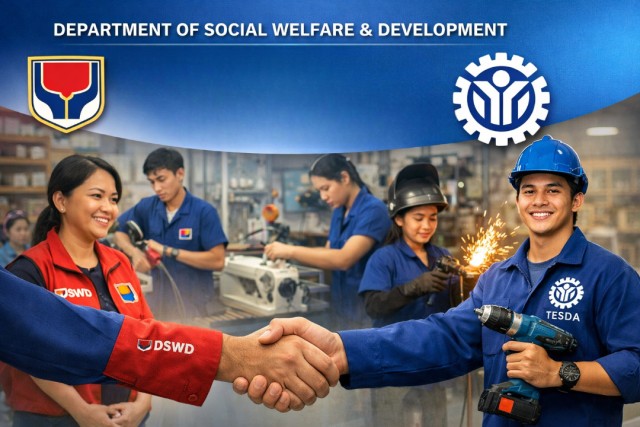
Here’s where things get practical. Many Filipinos don’t just need financial help. They need skills to get a job or start earning. That’s where TESDA comes in with these joint programs:
1. Cash-for-Training Program (C4TP)
DSWD and TESDA launched the Cash-for-Training Program to support disadvantaged youth aged 18–30, especially:
- Out-of-school youth
- College graduates without employment
- Youth from indigent families
- Beneficiaries assessed under DSWD programs
Each qualified beneficiary receives ₱20,000, which may cover:
- Scholarship vouchers
- Training costs
- Assessment fees
- Entrepreneurship support
- Starter tool kits
- Allowance
DSWD handles profiling and identification through LGUs. TESDA delivers the actual skills training under scholarship programs like TWSP.
2. Sustainable Livelihood and 4Ps Partnership
In August 2025, TESDA and DSWD signed a Memorandum of Agreement to expand access to free technical-vocational education and training (TVET) for:
- Current 4Ps beneficiaries
- Graduates who exited 4Ps
- Other marginalized families
Here’s how it works:
- DSWD identifies and endorses qualified participants.
- TESDA provides free training, assessment, and certification.
- Both agencies track outcomes like employment and income growth.
Free Training via TESDA Online Program (TOP)
Training is available face-to-face and through the TESDA Online Program (TOP), allowing beneficiaries to study from home, with no transportation cost and fixed schedules for free. It offers courses like:
- Caregiving
- Housekeeping
- Electrical installation
- Entrepreneurship
- Digital skills
Once certified, you can upload credentials to your TESDA Skills Passport, making it easier to show employers your verified qualifications.
Women in Non-Traditional Skills
DSWD and TESDA have also partnered under Gender and Development (GAD) programs. In Eastern Visayas, women under KALAHI-CIDSS received plumbing and masonry training from TESDA-accredited institutions. All passed NC II certification and were hired for community projects—finishing ahead of schedule. This proves one thing: skills open doors. In other words, you don’t have to stay stuck in crippling poverty because help does exist—but only if you are willing to take the first step.
If you’re tired of relying only on assistance and want something more stable, then start small. Enroll in one course. Finish it. Get certified. That’s how change begins.