The Department of Agriculture (DA) is the main government agency in the Philippines that looks after farming, fisheries, and food production. Founded in 1898, it helps farmers and fisherfolk grow more food, earn better income, and use modern and sustainable methods. It creates agricultural policies, gives financial and technical support, and runs programs that improve productivity, market access, and rural jobs.
DA works closely with the Technical Education and Skills Development Authority (TESDA) to turn knowledge into real-life skills. While DA provides seeds, machinery, research, policy direction, and funding programs, TESDA delivers hands-on training, scholarships, and National Certificate (NC) courses in agriculture to farmers, fisherfolk, and aspiring agripreneurs. Together, they train Filipinos so they don’t just receive support, but also learn how to use it properly and profit from it.
What Does DA Do?
To put it simply, you can think of the DA as the team that helps make sure there is enough food on every Filipino table. It was first created in 1898 and is led by the Secretary of Agriculture, appointed by the President of the Philippines. Over the years, it has evolved to meet the country’s changing needs—from improving rice and corn production to addressing climate challenges and strengthening food supply chains.
The DA was designed to ensure:
- Food Security: Works to maintain a stable supply of rice, corn, fish, meat, and vegetables across the Philippines.
- Farmer and Fisherfolk Support: Provides seeds, fingerlings, livestock, fertilizers, machinery, and technical assistance.
- Financial Assistance: Offers loan programs like SURE, ACEF, YALP, and other credit support for small farmers and youth.
- Research and Innovation: Develops improved crop varieties, climate-resilient farming methods, and modern technologies.
- Infrastructure Development: Supports irrigation systems, post-harvest facilities, and farm-to-market roads.
- Market Access: Helps farmers connect to buyers and monitor prices through marketing programs.
- Regulation and Food Safety: Issues permits, sets quality standards, and monitors agricultural products.
- Rural Job Creation: Encourages agribusiness growth, cooperatives, and local enterprise development.
- Support During Calamities: Provides recovery loans and assistance to farmers affected by disasters.
Its mission is simple: help farmers and fisherfolk increase productivity and income by helping farmers grow food, helping businesses sell food, and helping families put food on the table.
DA Programs
The DA runs many programs to support agriculture, including:
- Rice Competitiveness Enhancement Fund (RCEF): Provides machinery, seeds, credit, and training to rice farmers
- Agricultural Competitiveness Enhancement Fund (ACEF): Offers loans to farmers and cooperatives
- SURE Loan Program: Up to ₱25,000 loan at 0% interest for calamity-affected farmers
- Young Agripreneurs Loan Program (YALP): Up to ₱500,000 loan for young farmers and fishers
- National Organic Agriculture Program (NOAP): Supports organic farming
- Philippine Rural Development Project (PRDP): Improves agri-fishery infrastructure
But here’s the truth: giving equipment and loans is not enough. People need skills to maximize these resources. That’s where TESDA comes in.
How DA and TESDA Work Together
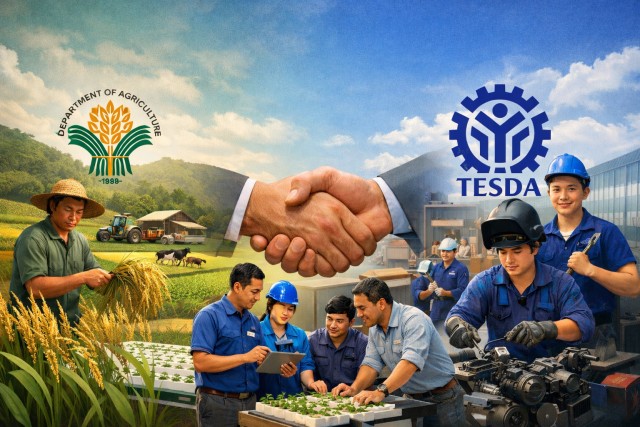
The DA and TESDA partnership focuses on modernizing agriculture through skills training and education.
1. Updated Agricultural Training Programs
In 2025, DA and TESDA strengthened their collaboration to update agricultural training aligned with new technologies. These include:
- Rice machinery operation
- Agri-entrepreneurship
- Postharvest technologies
- Cold storage and refrigeration systems
- Fisheries postharvest and canning operations
- Cooperative management
- Butchery and slaughterhouse operations
- Seaweed processing
TESDA develops the training modules in coordination with DA bureaus like the Fisheries Development Council.
2. National Certificate (NC) Courses in Agriculture
TESDA offers agricultural programs such as:
- Organic Agriculture Production NC II
- Animal Production (Poultry/Swine) NC II
- Aquaculture NC II
- Sugarcane Production NC II
- Halal Food Production
- Diploma in Fisheries Technology
These courses are available through institution-based, community-based, enterprise-based, and even online learning—making them accessible across the Philippines, including rural and remote areas. Many of these courses are funded under TESDA’s Training for Work Scholarship Program (TWSP).
3. Rice Extension and Farm Schools
Under RCEF, the DA (through the Agricultural Training Institute) and TESDA provide training and scholarships for rice farmers. They also support farm schools using “learning by doing” methods.
The goal? To not just give machinery—but to teach farmers how to operate and maintain it properly.
4. Urban Agriculture and Crisis Response
During the COVID-19 pandemic, DA and TESDA intensified urban agriculture training under the Plant, Plant, Plant Program (ALPAS). They trained residents in small-space vegetable gardening, rice production, livestock raising, and food value chains.
When food security becomes a concern, skills training becomes part of the solution.
Why This Matters
If you are:
- An OFW planning to return home
- An out-of-school youth looking for livelihood
- A farmer wanting to modernize
- A fisherfolk aiming to increase income
- A cooperative member
- Someone interested in agri-business
This partnership opens doors. After all, in agriculture today, knowledge matters just as much as seeds and soil. And when training meets opportunity, Filipinos are better prepared to grow food, build businesses, and create stable livelihoods.
If you’re thinking about entering agriculture—or leveling up—start with skills. Ask about scholarships under TWSP or RCEF by coordinating with your local DA Regional Field Office or reaching out to:
- DA Main Office: Elliptical Road, Diliman, Quezon City
- Tel: +63 (2) 8928-8741 to 64