The Department of Education (DepEd) is the government agency responsible for basic education—meaning elementary, junior high school, senior high school, and alternative learning systems. Its current mandate comes from Republic Act 9155 or the Governance of Basic Education Act of 2001. While DepEd creates policies, manages public schools, and works to give every Filipino access to quality basic education, the Technical Education and Skills Development Authority (TESDA) focuses on technical-vocational education and skills training for jobs such as welding, caregiving, IT, and other industry-based work. It sets training standards, assesses skills, and grants National Certifications that employers recognize.
As education-related agencies, DepEd and TESDA work together to strengthen technical-vocational education (TVET), especially in Senior High School (SHS). Together, they align school programs with industry standards, train teachers, offer national certifications, and build clearer pathways from education to employment. In simple terms: DepEd handles your basic schooling, and TESDA gives you practical skills that give you job-ready qualifications, helping you build a future you can stand on.
What is DepEd?

DepEd stands for the Department of Education (DepEd)—a government agency responsible for managing and supervising basic education, including elementary, junior high school, senior high school, and Alternative Learning System (ALS) programs. It creates policies, develops curriculum, and oversees both public and private basic education schools to make learning accessible and organized nationwide. It basically shapes the knowledge, values, discipline, and life skills of millions of Filipinos—laying the foundation for college, work, entrepreneurship, or skills training under TESDA.
DepEd basically:
- Develops and updates the K–12 curriculum for basic education
- Supervises and monitors public and private elementary and secondary schools
- Implements the Alternative Learning System (ALS) for out-of-school youth and adults
- Hires, trains, and manages teachers and school leaders
- Provides learning materials and sets academic standards
- Promotes safe, inclusive, and learner-centered school environments
DepEd History: How Philippine Education Evolved
Education in the Philippines wasn’t always done in classrooms with blackboards. Before Spanish colonization, learning was informal. Parents and tribal tutors focused more on life skills than books. During Spanish rule, education became religion-focused and limited. The Educational Decree of 1863 required towns to have primary schools. Under American rule, a centralized public school system was created in 1901 through Act No. 74. The Thomasites—600 American teachers—helped build the system.
Over the decades, the education department changed names many times. In 2001, Republic Act 9155 officially established today’s DepEd, focusing only on basic education after the education system was divided into three parts:
- DepEd – Basic Education
- TESDA – Technical-vocational and middle-level skills training
- CHED – Higher education
This “trifocal” system clarified who handles what. If you’re in elementary or high school, that’s DepEd. If you want hands-on job skills training, that’s TESDA.
How DepEd and TESDA Work Together
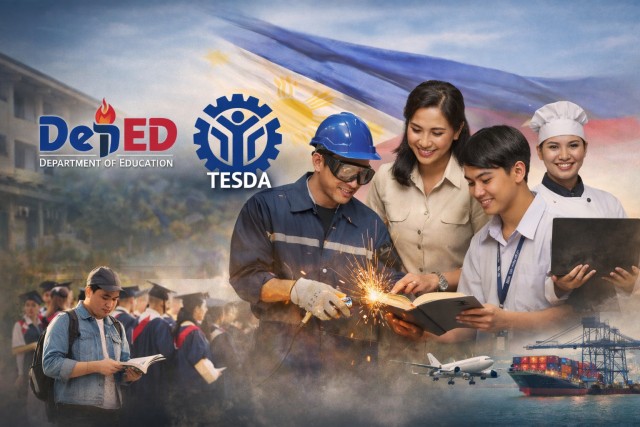
The line where school ends and skills training begins, is where DepEd and TESDA partnership starts. This partnership is designed for:
1. Strengthening Senior High School Tech-Voc Tracks
DepEd and TESDA signed a Memorandum of Agreement (MOA) to improve the Senior High School Technical Professional (TechPro) track. This means:
- SHS programs must follow TESDA Training Regulations
- Teachers must complete TESDA’s Trainers Methodology I (TM1)
- Students undergo assessment for National Certification
This helps students graduate not just with a diploma—but with a TESDA certificate that employers recognize.
As TESDA Director-General Jose Francisco Benitez said, embedding certification inside SHS creates a smoother transition from school to work.
2. Joint Management and Policy Alignment
In Clark City, Pampanga, DepEd, TESDA, and CHED held their first Joint Management Committee Conference. The goal? Avoid policy gaps and create smoother education-to-employment pathways.
They discussed:
- Data-sharing systems
- Senior High School tech-voc status
- Micro-credentials
- Credit transfer systems
- Teacher and trainer development
This is important because industries are changing fast—especially in IT-BPO, renewable energy, wearables, and semiconductor sectors. Schools must adapt quickly.
3. Raising the Image of TVET
In a SEAMEO forum, DepEd and TESDA talked about changing how people view tech-voc education. Many families still think college is the only “good” path. But research shows:
- 53.9% of SHS graduates pursue higher education
- Many enter the workforce immediately
- SHS graduates often earn more than junior high graduates
TVET is not a “backup plan.” It’s a direct path to employment.
And with DepEd and TESDA working together, the future is clearer—and more reachable—for every Filipino.