The Department of Science and Technology (DOST) is the Philippine government agency in charge of guiding and managing the country’s programs in science, technology, research, and education. Since becoming a full department in 1987, it has led national plans, funded research, offered scholarships, and supported Filipino inventors, students, and entrepreneurs.
More importantly for many Filipinos today, DOST works closely with Technical Education and Skills Development Authority (TESDA) to help technical-vocational graduates access modern equipment, digital learning tools, technology training, and business support. If you finished a TESDA course and want to start a business, upgrade your skills, or use advanced facilities, DOST can help.
What Does DOST Really Do?

DOST is the country’s “science and technology headquarters.” It started out in 1958 as the National Science and Development Board, became the National Science and Technology Authority in 1981, and officially became DOST in 1987. Its mission, despite the name change, has stayed the same: lead and coordinate the Philippines’ scientific and technological growth.
Here’s a list of what it actually does:
- It creates the National Science and Technology Plan
- It funds research projects and innovation
- It offers scholarships in science and engineering
- It supports laboratories and testing centers
- It helps businesses improve products using technology
- It promotes science awareness across the Philippines
Through agencies like PAGASA, PHIVOLCS, SEI, and research institutes nationwide, DOST supports everything from weather forecasting to food innovation. But if you’re a TESDA student or graduate, here’s what it promises: DOST doesn’t just fund scientists — it supports skilled workers too.
How DOST and TESDA Work Together
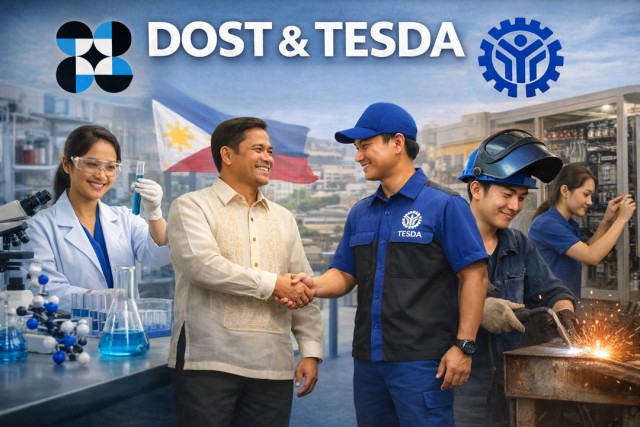
So, what does the DOST–TESDA partnership look like, you wonder? Well, here’s a simpler rundown of their joint projects:
1. Access to Advanced Equipment
TESDA graduates get priority access to DOST facilities.
- Welding graduates can use equipment at the DOST-Metals Industry Research and Development Center.
- Food processing graduates can work with DOST Food Innovation Centers (FICs) to improve recipes, packaging, and product quality.
You don’t even need a referral. You can go directly to a DOST regional office. They assess your needs and guide you.
2. STARBOOKS Digital Library in TESDA Centers
DOST installs STARBOOKS (Science and Technology Academic and Research-Based Openly Operated Kiosks) in TESDA training centers. It’s like a “digital library in a box.”
Even without internet, students can access:
- Scientific journals
- Technology guides
- Training resources
- Educational videos
This helps TESDA trainees learn beyond the classroom.
3. Technology for Livelihood
DOST helps TESDA graduates apply technology in real businesses.
Examples:
- Food product development
- Equipment improvement
- Product testing
- Packaging upgrades
If you’re starting small and don’t qualify yet for DOST’s Small Enterprises Technology Upgrading Program (SETUP) — which requires at least three years in business — DOST can still guide you on where to source equipment and how to improve production.
4. Entrepreneurial Support
Many TESDA graduates want to start a small business but don’t know where to begin.
DOST helps by:
- Giving technical advice
- Recommending appropriate technologies
- Supporting product development
- Connecting you to commercialization programs like OneSTore PH
This is especially helpful for:
- OFWs returning home
- Out-of-school youth
- Skilled workers shifting careers
5. Scholarships and Training
Through the Science Education Institute (SEI), DOST also offers:
- Undergraduate scholarships (RA 7687, Merit Program)
- Junior Level Science Scholarship (JLSS)
- Graduate scholarships (ASTHRDP, ERDT, CBPSME)
- Foreign graduate programs
- Scholarship for OFW dependents (up to Php 60,000 annual support)
If you or your child want to pursue science or engineering after a TESDA pathway, DOST scholarships are also available for you.
Why This Matters
DOST and TESDA work together in an attempt to bridge the gap between skills and technology. Simply put, if you are a TESDA trainee, but you don’t have capital, equipment, or support, DOST can support you, — especially in regional areas.
They even collaborate on policy-making, as DOST sits on the TESDA Board alongside DTI and DA. In short, as TESDA builds your technical skills, DOST helps you level up with science, equipment, and innovation.
Remember: There is science behind you. There is technology available to you. And there is a government agency ready to assist you in taking your next step—DOST.