The short answer is No. A TESDA Online Program (TOP) certificate proves you completed the TESDA Online Program course, while a TESDA National Certificate (NC) proves you can actually perform the job through a hands-on skills assessment. In other words, one shows that you studied the lessons, while the other shows that you can do the work according to industry standards.
Many jobs—especially skilled work and overseas positions—require a TESDA NC certificate. The TOP program helps you learn and prepare, but to become officially certified, you must pass a face-to-face competency assessment at a TESDA-accredited center.
What Is a TESDA Online Program (TOP) Certificate?
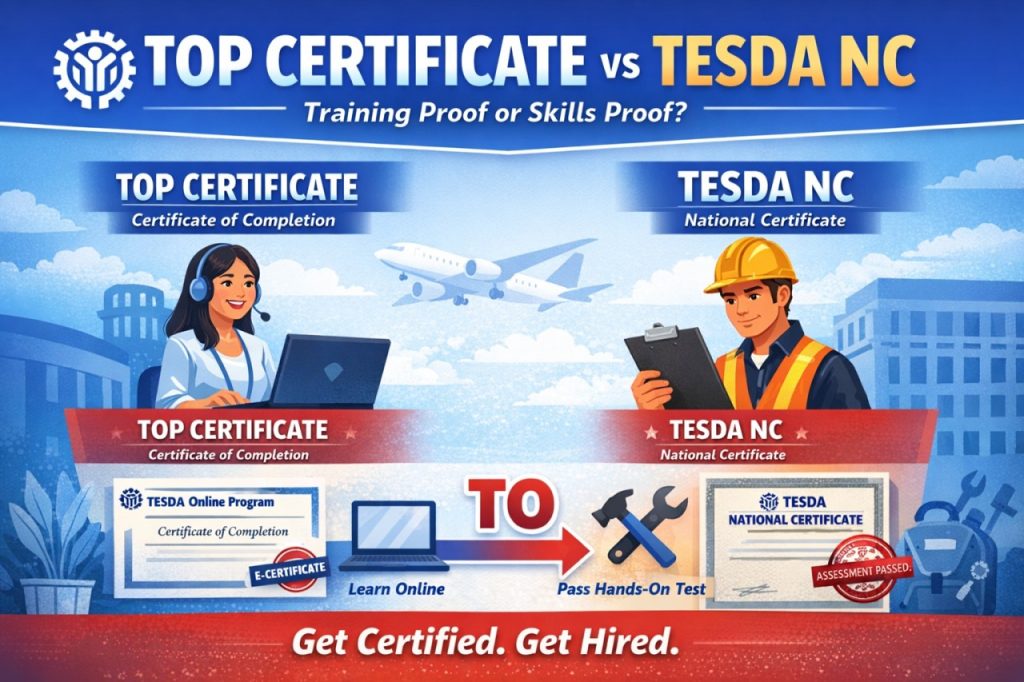
When you finish a course and pass the quizzes on the TESDA Online Program (TOP) course, the system gives you a Certificate of Completion or e-certificate. This certificate confirms that you completed the training modules and learned the theoretical lessons.
Here are the key points about a TOP certificate:
- It is a digital certificate issued after finishing a TESDA online course
- It proves you completed the training and learning modules
- Courses are free and self-paced online
- Anyone with internet access in the Philippines can enroll
- It is not a professional credential for employment
Think of the TOP certificate as proof of learning. It shows that you studied the material, but employers usually require proof that you can perform the skill in real work conditions. Still, TOP courses are extremely helpful. For OFWs, returning OFWs, out-of-school youth, and job seekers, they provide a flexible way to learn skills before taking the next step. You can explore courses here: https://e-tesda.gov.ph/course/.
What Is a TESDA National Certificate (NC)?
A TESDA National Certificate (NC) is the official credential issued after passing a competency assessment conducted by a TESDA-accredited assessment center.
Unlike a TOP certificate, the NC measures actual skill performance, not just knowledge. During the assessment, your abilities are evaluated through practical tasks such as:
- Demonstrating real workplace skills
- Completing job simulations
- Answering technical questions or interviews
If you pass the evaluation, TESDA issues a National Certificate, which is widely accepted by employers.
TESDA offers several NC levels:
- NC I – basic operational skills
- NC II – standard industry skills with limited supervision
- NC III – advanced technical work
- NC IV – supervisory or specialized roles
A TESDA NC certificate is often required for:
- Skilled jobs in the Philippines
- Work opportunities abroad for OFWs
- Promotions or higher pay
- Government or agency employment
Another important detail: TESDA NC certificates are valid for five years and may require renewal depending on the industry.
TOP Certification vs NC: The Real Difference
Many learners confuse these two certificates, especially after completing an online course. But their purpose is very different.
A TOP certificate confirms training, while an NC confirms competence.
The TOP certificate is earned by finishing an online course and passing quizzes. It shows you studied the lessons and understood the concepts.
The NC certificate, on the other hand, is issued only after you pass a hands-on competency assessment conducted by a TESDA-accredited center. This proves that you can perform the job according to industry standards.
This difference is why employers usually look for TESDA NC certification, especially in fields like:
- Cookery
- Housekeeping
- Massage therapy
- Computer systems servicing
- Front office services
For overseas work, the NC often serves as proof that a worker meets professional skill requirements.
Simply put, if your goal is learning, a TOP certificate is a good start. But if your goal is employment, promotion, or overseas work, the TESDA NC certificate is what most employers require. While both certificates are useful, the NC carries more weight in the job market. Sometimes, that difference can open doors—to employment, better pay, and new opportunities at home or abroad.