A TESDA National Certificate (NC) is an official credential issued by TESDA (Technical Education and Skills Development Authority) after a person passes a competency assessment. It proves that the holder has the skills, knowledge, and work attitude needed to perform a specific job based on national industry standards. In simple terms, it is a proof that shows employers that you can actually do the job—not just that you studied it.
If you’ve taken a skills training course, you need to pass a competency assessment with trained evaluators testing your skills so you can get a formal recognition document in the form of a TESDA certificate or TESDA NC that you can show employers to prove that you can actually do the work. This system helps workers, students, out-of-school youth, and returning OFWs show their abilities and qualify for better job opportunities locally and abroad.
Understanding the TESDA National Certificate (NC)
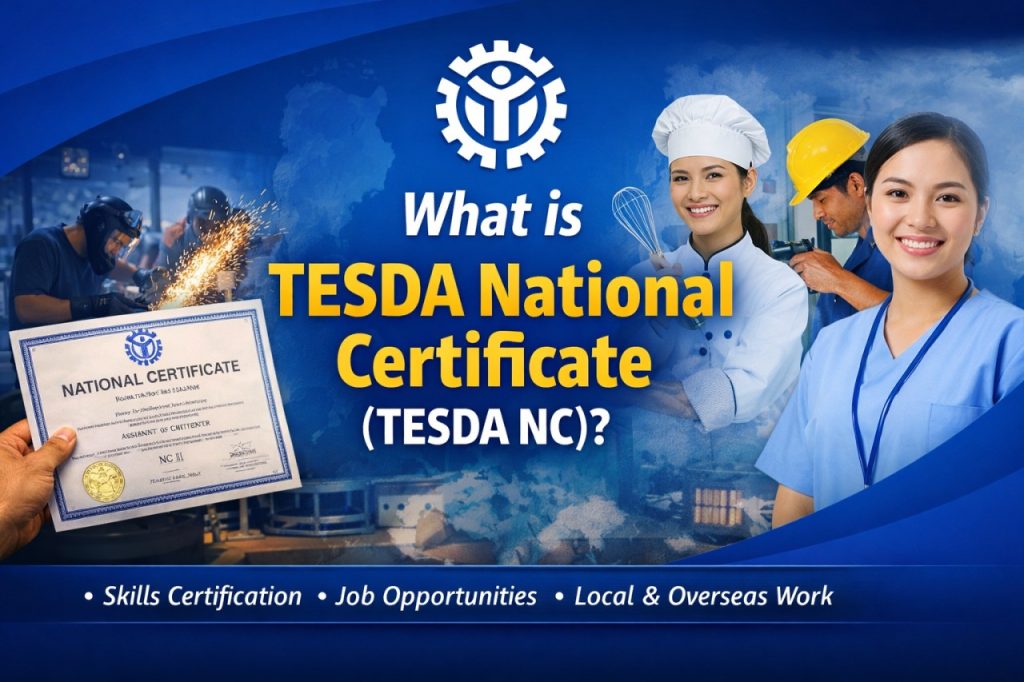
A TESDA National Certificate (NC) is a formal recognition issued to a worker or trainee who has passed a competency assessment conducted by TESDA-accredited assessors. These assessments are part of the Philippine TVET Competency Assessment and Certification System (PTCACS). The goal is simple: measure whether a person can perform tasks based on workplace standards defined in TESDA Training Regulations.
If you pass the assessment, TESDA issues the certificate and your name is included in the TESDA Registry of Certified Workers, a national database that employers can use to verify qualified workers. It serves as the physical proof that your skills meet the expectations of real workplaces.
TESDA NC Levels Explained
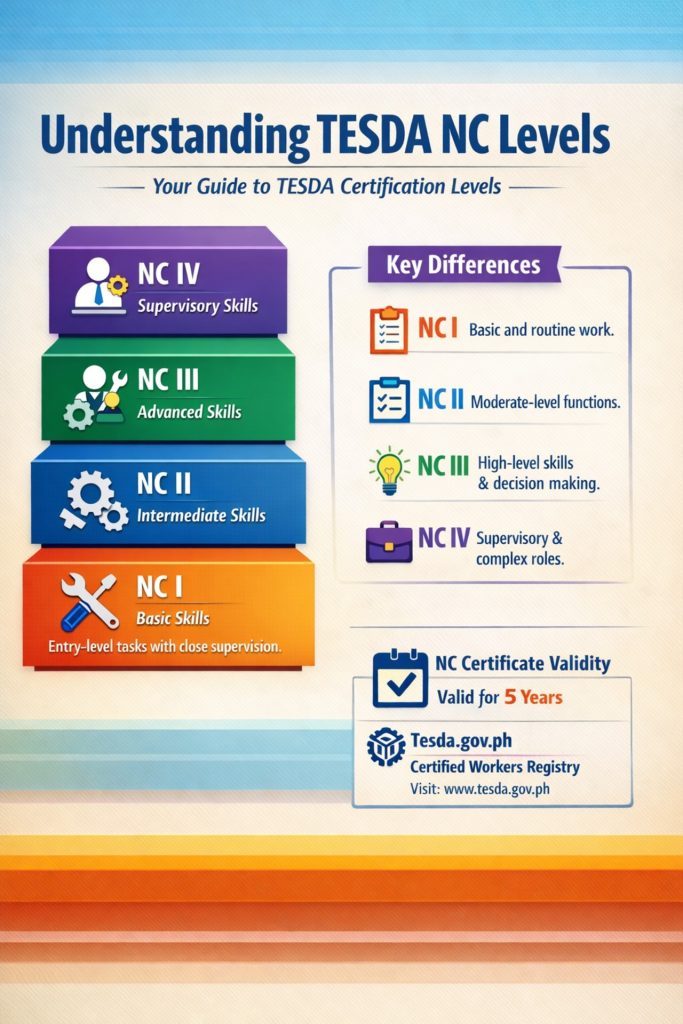
TESDA certifications are divided into several levels, depending on how complex the job skills are. Each level represents a different stage in a worker’s learning and experience.
NC I: Beginner Level
NC I is the starting point. This level focuses on simple and routine tasks that follow clear instructions. Workers with an NC I usually perform basic duties and operate under close supervision. It is ideal for beginners who are just entering a technical field.
Many people use NC I as their first step into vocational work in industries such as construction, agriculture, or service work.
NC II: Intermediate Level
NC II is the most common TESDA certificate. At this level, workers already have working knowledge and practical skills in their chosen field. They can perform a wider range of tasks with some independence, although procedures are still based on established routines.
Examples of popular TESDA NC II certifications include:
- Cookery NC II
- Caregiving NC II
- Computer Systems Servicing NC II
- Electrical Installation and Maintenance NC II
- Beauty Care NC II
For many Filipinos, especially OFWs and job seekers, NC II becomes the key qualification for employment.
NC III: Advanced Skilled Level
NC III represents a higher level of technical expertise. Workers at this stage handle more complex tasks and often use advanced tools or equipment. They are expected to solve problems, work more independently, and sometimes coordinate with other team members.
NC III certifications are common in technical fields where deeper knowledge and experience are needed.
NC IV: Supervisory and Technical Leadership Level
NC IV is an advanced certification level. Professionals with this certificate can handle complex, non-routine tasks and may supervise others. They also help organize work processes and contribute to improving procedures.
This level is usually associated with supervisory or technical leadership roles in industries.
NC vs COC: What’s the Difference?
Another certificate you might hear about is the Certificate of Competency (COC).
The difference is simple between these two types of certifications.
- A National Certificate (NC) is given when a person demonstrates competence in all required units of a qualification.
- Meanwhile, a Certificate of Competency (COC) is awarded when someone shows competence in specific units or clusters of skills within that qualification.
In simple terms:
- NC = full qualification
- COC = partial qualification
Many people earn several COCs first before completing the full qualification required for an NC.
Both certificates can be verified through the TESDA Registry of Certified Workers, which employers often check when hiring skilled workers. You can access the registry through the TESDA website:
http://www.tesda.gov.ph
What Does a TESDA NC Do
For many Filipinos, getting a TESDA NC is more than just a piece of paper. It is a gateway to better opportunities.
A TESDA certification can help you:
- Prove your skills to employers
- Apply for jobs locally or overseas
- Qualify for promotions or better pay
- Shift to a new career path
- Build credibility in your trade
Most importantly, it gives workers confidence that their skills meet recognized standards in the Philippines and beyond.
How TESDA Assessment Works
To receive a TESDA NC, you must pass a competency assessment. This evaluation measures your skills, knowledge, and work attitude.
Assessment methods may include:
- Demonstration or hands-on tasks
- Written exams
- Interviews or oral questioning
- Portfolio or work project submission
- Third-party reports from employers
Assessments are conducted by TESDA-accredited competency assessors at accredited assessment centers or TESDA institutions. Take note that anyone can apply for an assessment — students, workers, or individuals who want to prove their skill level.
Who Can Apply for a TESDA NC?
You can apply for competency assessment if you are:
- A TESDA graduate
- A worker with industry experience
- An OFW wanting recognized certification
- An out-of-school youth learning a trade
- Anyone who wants to prove their skills
You do not always need formal schooling if you already have practical experience.
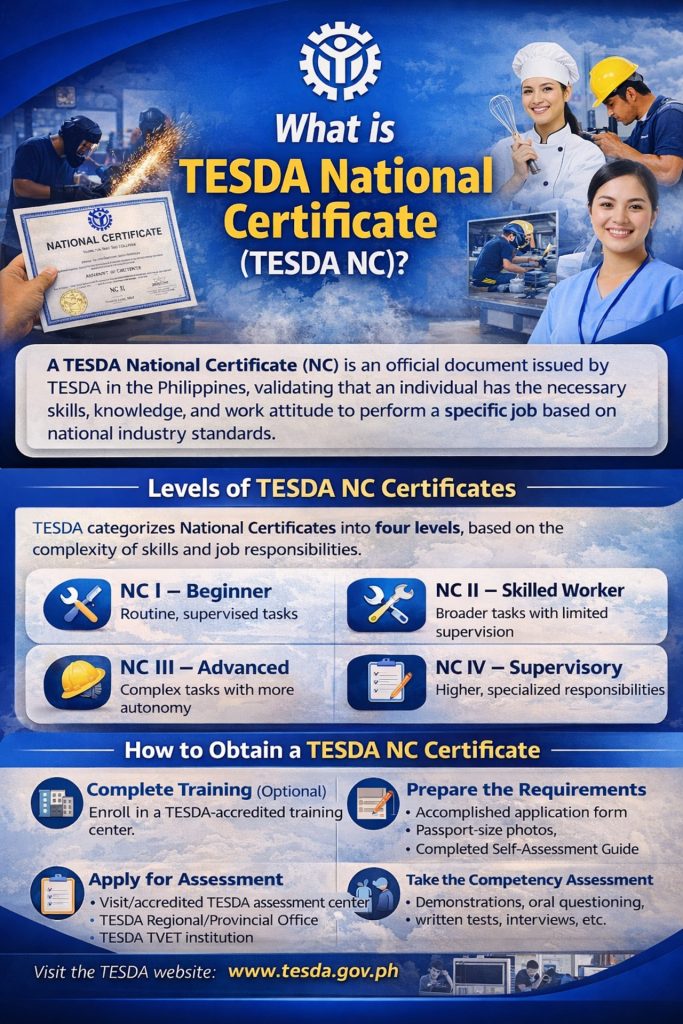
Requirements to Apply for TESDA Assessment
Applicants typically need:
- A duly accomplished application form
- Three passport-size photos with name written at the back
- A completed Self-Assessment Guide
You can apply at:
- TESDA Regional or Provincial Offices
- TESDA TVET institutions
- Private TESDA-accredited assessment centers
You can also learn more through TESDA’s official website:
http://www.tesda.gov.ph
How to Get a TESDA NC Certificate
If you want to obtain a TESDA certificate, the process is straightforward.
Step 1: Complete training (optional but recommended)
Enroll in a TESDA-accredited training center for your chosen course.
Step 2: Prepare the requirements
These usually include:
- Accomplished application form
- Three passport-size photos
- Completed Self-Assessment Guide
Step 3: Apply for competency assessment
You can apply at:
- TESDA-accredited assessment centers
- TESDA Regional or Provincial Offices
- TESDA TVET institutions
Step 4: Take the assessment
A TESDA-accredited assessor will evaluate your skills using practical demonstrations and other methods.
Step 5: Receive your TESDA NC certificate
If you pass, your certificate is released and your name will be added to the national registry of certified workers.
How Long Is a TESDA NC Valid?
A TESDA NC certificate is valid for five (5) years. After that, the certificate may need renewal. In some cases, holders must undergo another competency assessment, especially if new Training Regulations have been introduced. Renewal or replacement requests are usually processed at the TESDA Provincial or District Office where the certificate was issued.
Whether you are an OFW preparing for overseas work, a student exploring technical careers, or someone rebuilding a livelihood, earning a TESDA National Certificate (NC) can open doors to even better opportunities.